

How We Restore Purity
The process of decontaminating an exterior is about removing sources of contamination and restoring each panel to the state closest to how it appeared when it was manufactured. Detailing Wizards' process is carefully constructed for perfection to remove contaminants to the purest extent and to prevent risking further damage to any panel's clear coat or paint. Our process safely removes iron and tar before moving on to mechanical decontamination. We carefully balance our techniques, tools, and expertise for safe purity.
- Preparation - We prepare for decontamination by completing a full exterior detail of each vehicle to ensure we are able to remove all contaminants and prepare for protection
- Removal - Through chemical and mechanical processes, we remove deeply embedded contaminants by removing their bonds and pulling them away safely
- Protection - As a default, all Detailing Wizards services come with protection. We will apply the same protection as in our exterior process unless ceramic coating is requested
See our detailed process
Decontamination preparation
Over time, your vehicle's paint accumulates invisible contaminants that regular washing cannot remove. These include industrial fallout, brake dust, tar, tree sap, and mineral deposits. These contaminants bond to your paint and can cause etching and oxidation if left untreated. To remove these contaminants, we begin with the entire process of our exterior detailing service. Once the vehicle is sufficiently clean, it's ready for decontamination.
This service will perhaps be our simplest in terms of writing, but the skill, expertise, and patience required isn't quite as simple. The real challenge of completing this service is the extensive labor it requires and the skill to delicately remove contaminants that are toughly and deeply embedded in a car's paint without stripping away the clear coat or paint. If done improperly for any reason, clay bar and strong chemicals can easily cause damage to a vehicle's clear coat or paint. Detailing Wizards won't compromise the condition of your vehicle in the pursuit of perfection, but we still deliver purity.
Chemical decontamination
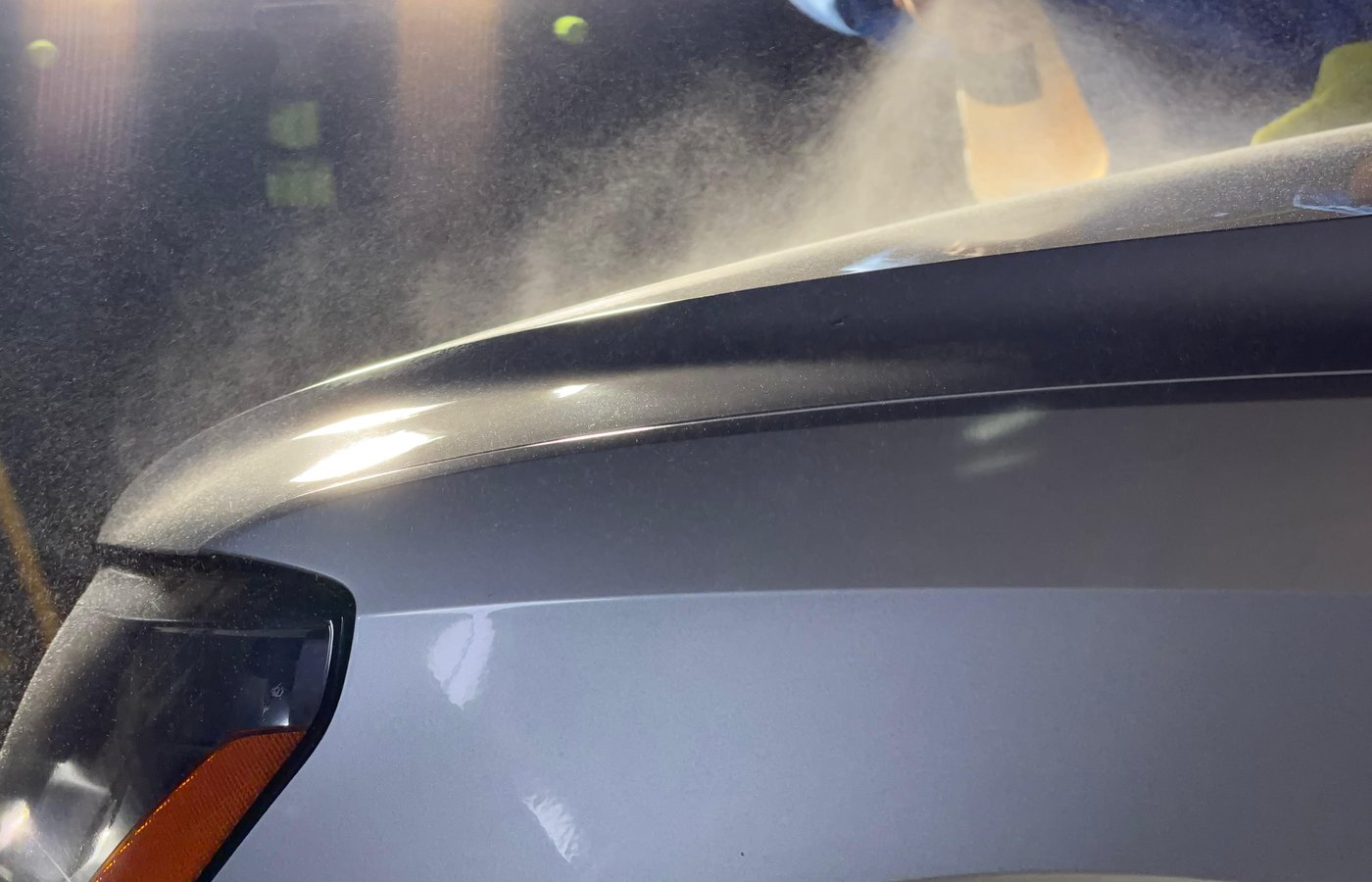
It's important that we begin with chemical decontamination first. This process allows us to remove the chemical bond between contaminants like iron brake dust, rust, and other metallic particles by applying Adam's Iron Remover. Iron remover is really removing the bond between iron and clear coat allowing for it to be far more easily extracted. A car's clear coat is porous. When the clear coat becomes hot or simply starts to age, the micro-size pours in the clear coat expand, allowing contaminants to become lodged. The iron remover works because it's a liquid that dissolves the small particles of iron and releases the bond it has to the clear coat. This allows the particles to safe escape the clear coat without damaging the paint or causing further damage to the paint itself. This is applied to all painted surfaces and wheels to dissolve embedded iron particles and brake dust.
It's important to not allow the liquid to sit since it is slightly acidic. We promptly thoroughly wipe excess iron remover away from painted surfaces and rinse thoroughly. We will apply a Stoner Tarminator tar remover as needed for stains caused by tree sap, road tar, adhesive residue, and even bug splatter. This works in the same principle as the iron remover. It's important to remove as much tar contamination as possible through chemical decontamination rather than mechanical since it's very easy to strip away the clear coat and even underlying paint. A novice detailer may be familiar with the heart sinking feeling of seeing paint streaks on their clay bar while sap still happily sits on the car. Detailing Wizards combines knowledge and skill to effortlessly handle such situations without causing that damage.
Mechanical decontamination
We begin mechanical decontamination to remove embedded particles that cannot be dissolved, but can be loosened and removed by hand. It's important to remove each speck or grain by hand to precisely remove all contaminants without causing damage. We begin with a clay towel specifically. Clay towel contours to the vehicle and can easily remove embedded contaminants from a large area without risking marring the paint or clear coat. A clay bar is sticky and physically grabs the surfaces it touches. We only use clay bar in highly specific situations where it can be done safely without causing risk of removing paint or clear coat. While using the clay bar or clay towel, it's important to lubricate the clay so that it's able to pull away only contaminants without attaching to the paint. Clay towels are also easier and safer to use in this way since they can be lubricated easily.
While using a clay towel or clay bar, we use light pressure and focus on a single panel at a time split up into sections. It's important to rinse and dry the vehicle one more time once finished. At the end of mechanical decontamination, we'll review and double check for any more possible missing contaminants and ensure the entire car has been completely treated. After this, if a ceramic coating or paint correction is not requested, we will seal the car with a protective ceramic spray just as it's outlined in our exterior detailing service. The decontamination process allows for protective layers to adhere to the porous clear coat and have a significantly stronger bond, higher quality finish, and retain the visual identity of a car's paint while allowing for it to last longer.
If our customer wishes to move onto ceramic coating, we'll next consider if further paint correction is beneficial to our customer and offer guidance. In either case, and no matter the age of the car or its type of clear coat, the car will be ready to protect with a ceramic coating.
Sealants and coatings dramatically slow this process, but they do not recreate the original factory coating. Over time, UV protection wears down, especially on a surface that sits at the very front of the vehicle and takes constant abuse. That's why maintenance or reapplication is necessary. Without ongoing protection, headlights will always re-oxidize.
In short, restorations that don't last forever aren't being done wrong, but plastic exposed to the elements simply will always age. To properly maintain headlights, restorations will need to be performed over time, but in doing so, the total age of a headlight's light output and performance will be prolonged significantly. Detailing Wizards is offering this transparency because we believe it's important that customers are aware of the current limitations of headlight restorations, but can also rest assured that we provide the absolute highest-end service ensuring your headlights will last in their best shape for the longest time possible.
Book Now to Reserve Your Slot.
