

How We Restore Paint
Paint correction is a precise service that focuses on removing defects in a car's clear coat. This requires a high level of attention and must be done evenly across the entire surface to remove only the tiniest possible layer of damaged clear coat. Detailing Wizards regulates the process carefully to preserve as much clear coat as possible.
- Preparation - Preparation is important for every Detailing Wizards' service. For paint correction, proper preparation is imperative to deliver the highest quality results
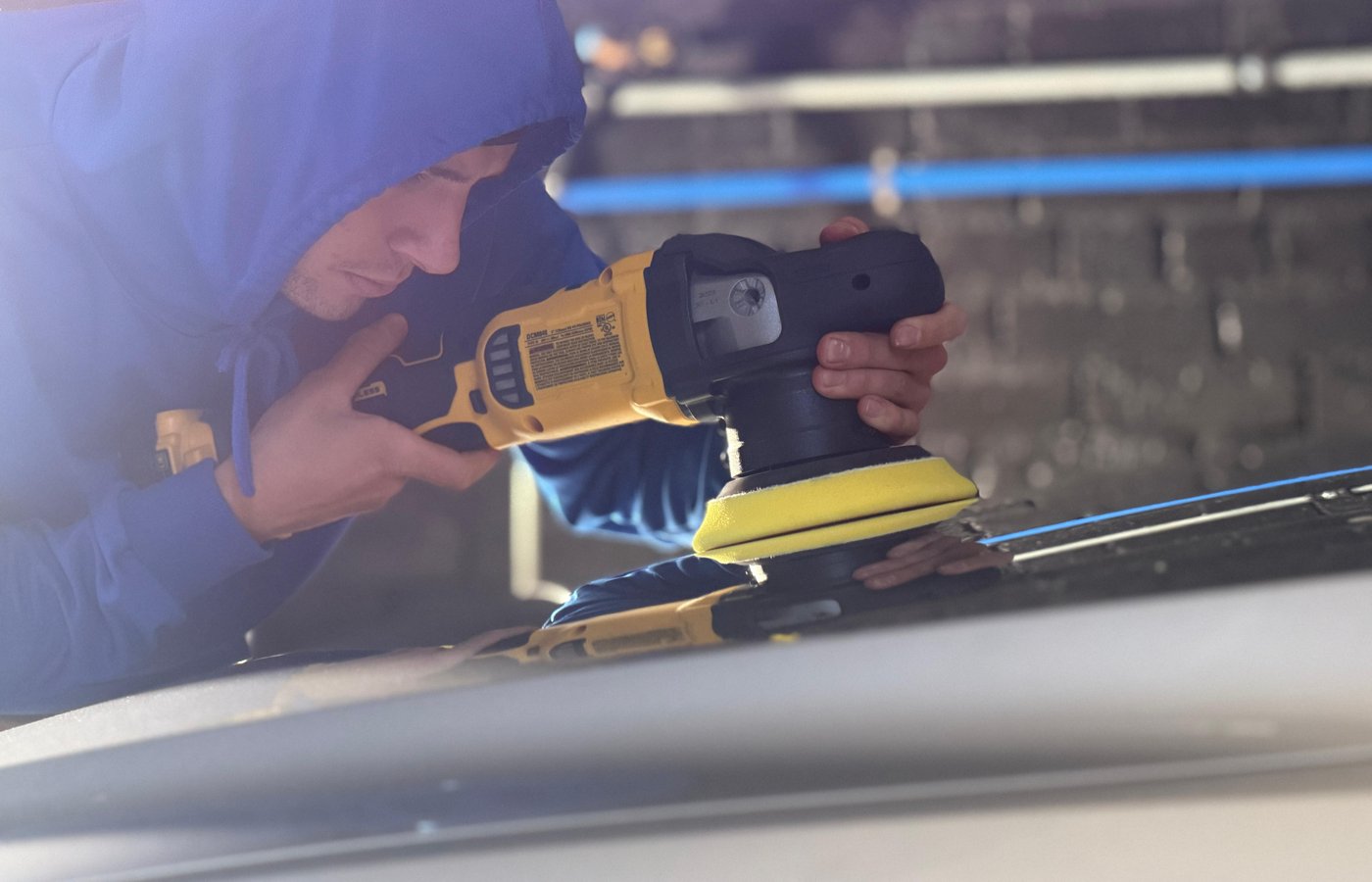
- Polishing - Removes oxidation and imperfections in surface or deep layers of the paint's clear coat
- Protection - After polishing, we will seal the clear coat with a standard sealant or with our separate and recommended ceramic coating service for the highest quality clarity, durability, and protection
See our detailed process
This process of removing the clear coat may seem counter intuitive. By performing paint correction and following this process it's a strong protective layer like a ceramic coating, the car's paint becomes more protected while retaining more of the clear coat than if it were to simply be left to wear over time. It's nearly identical to the process of having your teeth cleaned by a dentist. Our process results in a long-lasting beautiful shine that remains protected and valuable.
Preparation and inspection
We begin by inspecting each panel's paint and clear coat using white-balanced LED inspection lights. We inspect under diffuse lighting and point-source lighting. Additionally, we inspect under natural sunlight when available. This inspection process is crucial as it allows us to identify swirls, RIDS (random isolated deep scratches), holograms, oxidation, etching, staining, and any other defects. We record embedded defects, defects under the clear coat, and surface-level, light defects. We use a paint thickness gauge to assess the depth of the clear coat as well as the paint. We record differences between panels as well as edges and high spots. We also record any areas that may have been repainted or temporarily covered.
Paint correction only removes small layers of the clear coat. We assess the thickness of the clear coat to determine how aggressive our correction process should be for each panel and section. Through our experience, we also account for trends in differences between manufacturers and their paint hardness. Detailing Wizards chooses pad material, polishing machine type, the number of passes, and overall abrasion depending on the hardness level assessed through the experience we have built since becoming established in 2018. Too much abrasion risks damaging paint, and too little leaves the defects visible. Much like a dentist drilling and filling a cavity, it's extremely important to proceed with caution and expertise.
Chemical decontamination
Before we can begin correcting paint, we must decontaminate the clear coat. We use iron remover to remove particles of brake dust and other fallout. Iron remover breaks down the bond between the clear coat and iron and removes particles without any risk of abrasion. This step is important so that micro scratches do not occur during the polishing process. Tar remover is used with the same concept for any contaminants that stick to the clear coat like sap, old grease and oil, and any other contaminants. Once we finish chemical decontamination, we begin mechanical decontamination.
Mechanical decontamination
Detailing Wizards removes deeply embedded contaminants to avoid causing further defects during the paint correction process. To remove surface and deeply embedded contaminants, we use a clay bar or clay towel. These physically grab contaminants like rocks, dirt, and other small particles and pull them out of the clear coat. We begin with a clay towel since it's much less abrasive and doesn't pose the same risk of stripping away the clear coat and paint like a clay bar does. It's important to use extreme caution during this step to not cause any damage to the clear coat or paint itself. We only use these products as absolutely necessary and we polish afterward.
We establish a small section as a test section and polish it before committing to our full process. We determine the correct level of polishing for each section by beginning with our least aggressive pad and polish. We will use a dual action polisher, rotary polisher, or forced rotation polisher as needed determined by size, shape, flatness, and complexity of each section of a panel. This is determined through experience as well as documented best results across all our work. We will increase abrasion only as absolutely necessary. For each type of defect, we use a specialized process.
Polishing
For light swirls and marring with an adequate clear coat and no heavy RIDS, we begin with our polisher using a finishing or light cut pad along with a fine abrasive polish. This process will remove most visible defects while removing only a minimal undetectable layer of the clear coat.
For moderate swirls with a moderate clear coat and paint thickness and only light RIDS, we begin with cutting. We use a dual action or forced rotation polisher with a microfiber or foam cutting pad. We use a medium to heavy compound depending on the depth of a given section. We'll then refine the area with a softer pad and finish with a fine finishing polish. This process will correct for most defects if not all for a typical vehicle that has not been corrected and coated.
For heavy defects and older uncorrected and non-protected paint with evidence of heavy RIDS, oxidation, etching, or heavy marring from previous improper polishing, we'll move onto our most abrasive process. We use a rotary polisher for the initial cut along with a heavy compound. We'll make multiple passes as needed. It's important to proceed with extreme caution during this step, as inexperience can lead to cutting too deeply and removing the clear coat entirely. The objective is to only cut a minimal amount of clear coat and protect it as much as possible.
Spot Sanding is only used with extreme caution as an absolute last-resort depending on what the customer's goals are for paint correction. If desired for heavily defected sections, we use a fine grit up to 3000 before finishing with compound and fine polish.
Characteristics of paint types
Detailing Wizards' expertise has allowed Jake Ramos to develop clear methods for how to interpret and correct various paint types. Hard, soft, aged, and damaged paint all have widely different characteristics and it's important to approach each type with knowledge and skill to deliver the absolute highest quality service.
Hard paint is physically stronger, meaning that defects are more difficult to acquire, but also more difficult to remove. This creates a lower risk scenario for those who may be inexperienced, but it's still important to use the right tools only as they are necessary. This means that hard paint will typically require more steps than softer paint. After correction, hard paint finishes smoothly more easily.
Soft paint that can be found very commonly in Japanese manufacturers tends to have the opposite characteristics of hard paint. Defects form more easily, but are also more easy to remove. It's important to proceed with extreme caution when working with soft paint as it's much easier to marr, or further defect the paint than on hard paint. Swirls can easily be introduced if not cleaned, polished, and dried correctly. This makes the refining process more important.
Aged paint will have a thinner clear coat due to damage from UV rays or in some cases no clear coat at all. With vehicles like these, it's extremely important to balance removal processes. Removing oxidation and other defects could easily lead to removing paint itself. Vehicles like these should be left to professional premium level servicers. The same applies to severely damaged paint as the clear coat may be compromised. If the paint is too damaged and correction cannot be performed, the recommendation may be to repaint the section or entire panel instead.
Final touches and inspection
After finishing polishing, we wipe each panel with IPA to remove any residue or streaks from polishing. We will reinspect each panel as we did before to confirm no swirls, RIDS, holograms, oxidation, etching, staining, and any other defects are present. We confirm that each panel is finished uniformly and upholds Detailing Wizards high expectation of quality. To finish our process, we apply a ceramic coating as detailed on our ceramic coating service page. If a customer does not wish to proceed with a ceramic coating, we will apply a complimentary ceramic sealant as detailed in our exterior detailing service page.
Book Now to Reserve Your Slot.
